Prerequisites
Given an integer n representing the number of courses labeled from 0 to n - 1, and an array of prerequisite pairs, determine if it’s possible to enroll in all courses.
Each prerequisite is represented as a pair [a, b], indicating that course a must be taken before course b.
Example:
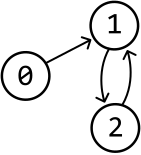
Input: n = 3, prerequisites = [[0, 1], [1, 2], [2, 1]]
Output: False
Explanation: Course 1 cannot be taken without first completing course 2 and, and vice versa.
Constraints:
- For any prerequisite
[a, b],awill not equalb.
Intuition
Our goal is to check if enrollment into all courses is possible. Let’s start by identifying which situations make enrollment impossible.
Consider a simple case where there are just two courses. A scenario where enrollment into all courses is impossible occurs when each course is a prerequisite to the other, as graphically represented below:
![Image represents a directed graph illustrating prerequisites, where prerequisites = [[0, 1], [1, 0]] defines the dependencies. The graph consists of two nodes, represented by circles labeled '0' and '1'. A directed edge, indicated by an arrow, connects node '0' to node '1', signifying that node '1' requires node '0' as a prerequisite. Conversely, another directed edge connects node '1' to node '0', indicating a reciprocal dependency; node '0' also requires node '1'. The prerequisites array is a matrix where each inner array represents a dependency; [0, 1] means 1 depends on 0, and [1, 0] means 0 depends on 1. This visual representation shows a cyclical dependency between the two nodes.](/courses/coding-patterns/images/prerequisites-2.svg)
Here are a couple of impossible enrollment scenarios that could occur with prerequisites for three courses:
![Image represents two directed graphs illustrating different prerequisite relationships. Each graph contains three nodes labeled '0', '1', and '2', representing tasks or modules. Arrows indicate dependencies; an arrow from node A to node B signifies that B requires A as a prerequisite. The left graph shows node 0 pointing to node 1, node 1 pointing to node 2, and node 2 pointing back to node 1, representing a cyclical dependency. Above this graph, the text 'prerequisites = [[0,1] [1,2] [2,1]]' lists these dependencies as ordered pairs within a list of lists. The right graph shows node 0 pointing to node 1, node 1 pointing to node 2, and node 2 pointing to node 0, forming a different cyclical dependency. Above this graph, the text 'prerequisites = [[2,0] [0,1] [1,2]]' similarly lists the dependencies as ordered pairs in a list of lists, reflecting the connections in the graph. Both graphs visually represent different sets of prerequisites, highlighting how different dependency structures can be represented using directed graphs and their corresponding list representations.](/courses/coding-patterns/images/prerequisites-3.svg)
What do we notice about these cases and their graphical representations? They both have a circular relationship: a cycle. This highlights that it’s impossible to enroll in all courses if there exists a circular dependency between courses. In other words, there must not be a cycle in the graphical representation of the courses for complete enrollment to be possible.
Another thing to note is that the first courses which can be completed are those without prerequisites. In the graphical representation, such a course would have no directed arrows pointing at them. Let’s refer to the number of directed edges incoming to a node as the in-degree of that node.
In the example below, each node’s in-degree is displayed at the top right:
![Image represents a directed graph illustrating prerequisites. The graph consists of six nodes, numbered 0 through 5, represented as circles containing their respective numbers. Arrows indicate directed edges showing dependencies; a directed edge from node x to node y means y depends on x. The edges are labeled with small orange numbers, possibly representing weights or costs associated with the dependencies. Specifically, node 0 has outgoing edges to nodes 1 and 2; node 1 has an outgoing edge to node 4; node 3 has an outgoing edge to node 2; node 2 has an outgoing edge to node 4; and node 4 has an outgoing edge to node 5. Above the graph, a Python list named prerequisites is defined, containing nested lists. Each nested list represents a dependency pair; for example, [0,1] indicates that node 1 depends on node 0. The list explicitly defines all the dependencies shown in the graph.](/courses/coding-patterns/images/prerequisites-4.svg)
Courses 0 and 3 have an in-degree of 0. So, let’s complete them first and remove them from the graph. By doing this, we reduce the number of prerequisites for courses 1 and 2. Course 1’s indegree then decreases by 1, and course 2’s indegree decreases by 2:
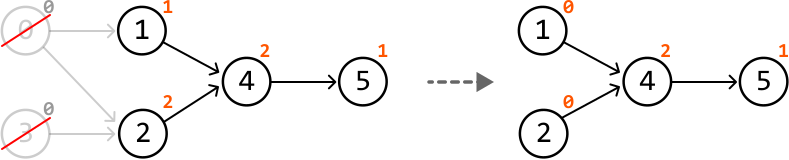
Now, courses 1 and 2 have an in-degree of 0, which means we can enroll in them and remove them from the graph. Observe what happens when we continue the process of removing courses with an in-degree of 0 from the graph:
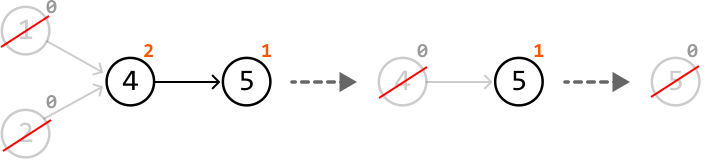
By the end of this process, no courses remain, indicating it’s possible to enroll in all courses.
Now, consider an example with a cyclic dependency:
![Image represents a directed graph illustrating prerequisites. At the top, a Python list named prerequisites is defined, containing pairs of numbers representing dependencies: [[0,1] [0,2] [3,2] [1,4] [2,4] [4,5] [5,2]]. The graph visually depicts these dependencies. The graph consists of six nodes, numbered 0 through 5, represented as circles containing their respective numbers. Directed edges, represented by arrows, connect the nodes, indicating the flow of dependencies. For example, the edge from node 0 to node 1 (labeled with an orange '1' above the arrow) signifies that node 1 requires node 0 as a prerequisite. Similarly, node 2 requires node 0 (labeled '0'), node 2 requires node 3 (labeled '3'), node 4 requires node 1 (labeled '2'), node 4 requires node 2 (labeled '1'), node 5 requires node 4 (labeled '1'), and node 2 requires node 5 (a curved edge). The numbers on the arrows correspond to the order of dependencies as listed in the prerequisites list.](/courses/coding-patterns/images/prerequisites-7.svg)
Let’s follow the same steps of removing courses with an in-degree of 0:

Here, there is no way to progress because there aren’t any courses with an in-degree of 0. When this happens, and there are still unvisited courses, a cyclic dependency exists, meaning enrolment is impossible.
Now, let’s identify a way to simulate the above process algorithmically.
Topological sort
The process we described above is essentially topological sorting, where vertices of a graph are sorted in such a way that for every directed edge u → v, node u comes before node v in the ordering of the topological sort.
An algorithm designed to perform topological sort is Kahn’s algorithm. Let’s see how we can use it to solve this problem.
The first step of Kahn’s algorithm is to determine the in-degree of each course. This can be achieved by counting the number of times each course appears as a dependent in the prerequisite pairs: for a pair [a, b], course b depends on course a, so course b’s in-degree is incremented by one:
![Image represents a directed acyclic graph (DAG) illustrating a topological sort problem, along with its prerequisites and in-degrees. The upper part shows the DAG with six nodes (0, 1, 2, 3, 4, 5) represented as circles, connected by directed edges indicated by arrows. The numbers on the arrows represent edge weights (not explicitly defined but implied). Node 0 points to node 1 and node 2; node 3 points to node 2; node 1 points to node 4; and node 4 points to node 5. Below the DAG, a list named 'prerequisites' shows the dependencies as pairs of node indices: [[0,1] [0,2] [3,2] [1,4] [2,4] [4,5]], indicating that node 1 requires node 0, node 2 requires node 0, node 2 requires node 3, node 4 requires node 1, node 4 requires node 2, and node 5 requires node 4. Finally, a list named 'in_degrees' shows the number of incoming edges for each node: [0 1 2 0 2 1], indicating that node 0 has 0 incoming edges, node 1 has 1, node 2 has 2, and so on. Orange curved arrows connect the prerequisites pairs to their corresponding in-degree values in the in_degrees list, visually linking the dependencies to the count of incoming edges for each node. The numbers below the in_degrees list (0, 1, 2, 3, 4, 5) correspond to the node indices.](/courses/coding-patterns/images/prerequisites-9.svg)
Now, we want to process all the courses with an in-degree of 0 first. We can add these courses to a queue to be processed:
![Image represents a directed acyclic graph (DAG) with five nodes (0, 1, 2, 3, 4) and edges connecting them, along with an accompanying illustration of a topological sort algorithm's execution. The nodes are numbered 0 through 4 and are depicted as circles containing their respective numbers. Edges are represented by arrows indicating direction; for example, node 0 points to node 1, and node 3 points to node 2. Small orange numbers next to each edge indicate a weight or some associated value. The algorithm uses an in_degrees array, shown as [0 1 2 0 2 1], representing the number of incoming edges for each node (node 0 has 0 incoming edges, node 1 has 1, and so on). A queue array, initialized as [0 3], stores nodes with zero incoming edges. A light green highlight visually emphasizes the current state of the in_degrees array, showing that nodes 0 and 3 are initially in the queue because they have no incoming edges. The graph's structure and the in_degrees and queue arrays together illustrate the data structures used in a topological sorting algorithm.](/courses/coding-patterns/images/prerequisites-10.svg)
To begin processing, pop the first course from the queue: course 0. Then, for each course that has course 0 as a prerequisite (i.e., courses pointed to by course 0), reduce their in-degree by one:
![Image represents a directed acyclic graph (DAG) illustrating a topological sort algorithm. The DAG consists of five nodes (circles) numbered 1 through 5, with directed edges (arrows) indicating dependencies. Node 0 is shown in gray and crossed out, indicating it's a source node that has been processed. A directed edge from node i to node j implies that node j depends on node i. The edges are labeled with small numbers representing weights or counts (e.g., 1→0, 2→1). To the right, an array named in_degrees is shown, representing the in-degree of each node (number of incoming edges). Initially, in_degrees is [0, 1, 2, 0, 2, 1], with node 0's in-degree crossed out because it's processed. Another array, queue, is shown as [0, 3], indicating nodes with an in-degree of 0 (ready to be processed). The orange numbers on the nodes and edges likely represent the order of processing during the topological sort. The graph visually demonstrates the flow of information and dependencies, with the arrays tracking the algorithm's progress.](/courses/coding-patterns/images/prerequisites-11.svg)
If any of the courses have an in-degree of 0 after being decremented, add them to the queue. Course 1 now has an in-degree of 0, so we add it to the queue:

We can continue the above process until the queue is empty, indicating that there aren’t any more courses with an in-degree of 0.
- If we’ve processed all n courses, enrollment to all courses is possible.
- If we couldn’t process all n courses, a cycle was found, indicating enrollment to all courses is impossible.
Implementation
Python
JavaScript
Java

from typing import List
from collections import defaultdict, deque

def prerequisites(n: int, prerequisites: List[List[int]]) -> bool:
    graph = defaultdict(list)
    in_degrees = [0] * n
    # Represent the graph as an adjacency list and record the in-degree of each
    # course.
    for prerequisite, course in prerequisites:
        graph[prerequisite].append(course)
        in_degrees[course] += 1
    queue = deque()
    # Add all courses with an in-degree of 0 to the queue.
    for i in range(n):
        if in_degrees[i] == 0:
            queue.append(i)
    enrolled_courses = 0
    # Perform topological sort.
    while queue:
        node = queue.popleft()
        enrolled_courses += 1
        for neighbor in graph[node]:
            in_degrees[neighbor] -= 1
            # If the in-degree of a neighboring course becomes 0, add it to the queue.
            if in_degrees[neighbor] == 0:
                queue.append(neighbor)
    # Return true if we've successfully enrolled in all courses.
    return enrolled_courses == n

Complexity Analysis
Time complexity: The time complexity of prerequisites is O(n+e)O(n+e)O(n+e) where eee denotes the number of edges derived from the prerequisites array. Here’s why:
-
Creating the adjacency list and recording the in-degrees takes O(e)O(e)O(e) time because we iterate through each prerequisite once.
-
Adding all courses with in-degree 0 to the queue takes O(n)O(n)O(n) time because we check the in-degree of each course once.
-
Performing Kahn’s algorithm takes O(n+e)O(n+e)O(n+e) time because each course and prerequisite is processed at most once during the traversal.
Space complexity: The space complexity is O(n+e)O(n+e)O(n+e), since the adjacency list takes up O(n+e)O(n+e)O(n+e) space, while the in_degrees array and queue each take up O(n)O(n)O(n) space.