Binary Tree Columns
Given the root of a binary tree, return a list of arrays where each array represents a vertical column of the tree. Nodes in the same column should be ordered from top to bottom. Nodes in the same row and column should be ordered from left to right.
Example:
Output: [[2], [9], [5, 1, 4], [3], [7]]
Intuition
First and foremost, to get the columns of a binary tree, we’ll need a way to identify what column each node is in.
Column ids
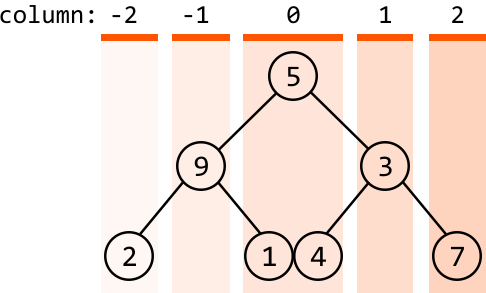
One way to distinguish between different columns is to represent each column by a distinct numerical value: an id. Initially, we don’t know how many columns there are to the left or to the right of the root node, but we at least know the column which contains the root node itself. Let’s give this column an id of 0. This lets us set positive column ids for nodes to the right of the root and negative ids to the left:
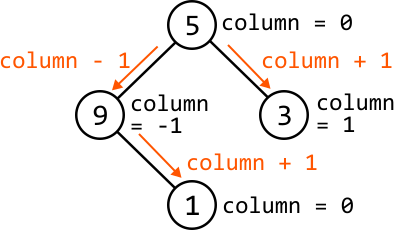
How can we identify what column id a node is associated with? A handy observation is that every time we move to the right, the column id increases by 1, and every time we move to the left, it decreases by 1. This allows us to assign ids as we traverse the tree: for any node, the column ids of node.left and node.right are column - 1 and column + 1, respectively:
Tracking node values by their column id
Now that we have a way to determine a node’s column, we’ll need a way to keep track of which node values belong to which columns. This can be done using a hash map where keys are column ids and the value of each column id is a list of the node values at that column.
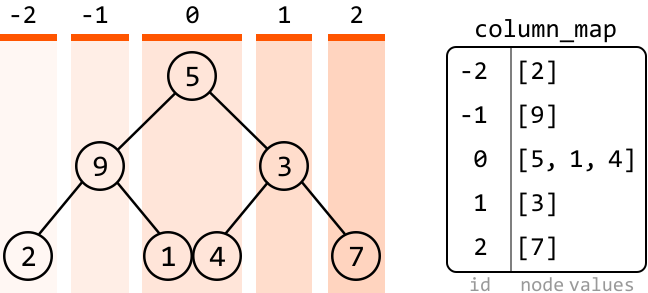
Now, let’s consider what traversal algorithm we should use to populate this hash map.
Breadth-first search
In general, we can employ any traversal method to assign column ids to each node, as long as we increment the column id whenever we move right and decrement it whenever we move left. However, we need to be cautious about the following two requirements:
-
Nodes in the same column should be ordered from top to bottom.
-
Nodes in the same row and column should be ordered from left to right.
So, we’ll need an algorithm that traverses the tree from top to bottom and then from left to right. This calls for BFS.
BFS processes nodes level by level, starting from the root and moving horizontally across the tree at each level. This method ensures nodes are visited from top to bottom, and for nodes in the same row (level), they are visited from left to right.
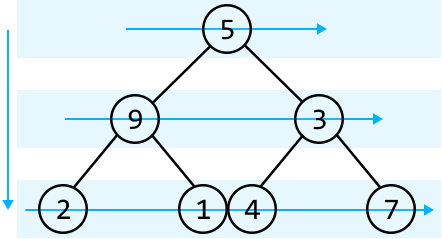
Traversing the tree this way ensures node values are added to the hash map in the desired order, complying with the two requirements above.
We can see how the hash map is populated level by level below:
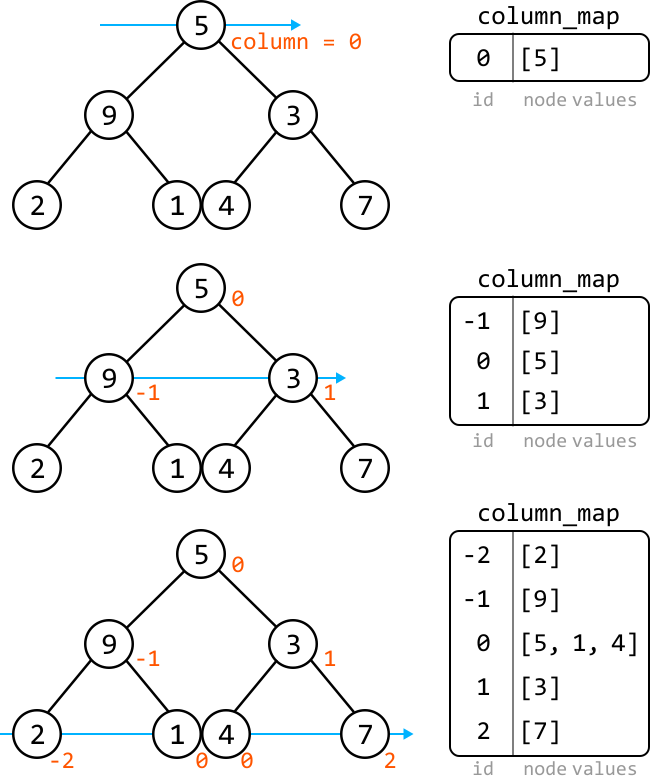
Once BFS concludes, the hash map is populated with lists of values for each column id. However, the hash map itself is not the expected output. So, let’s discuss what to do next.
Creating the output
This problem expects us to return the column ids from left to right. As we know, a hash map does not inherently maintain the order of its keys (column ids), which means we’ll need to find a way to attain the output in the desired order.
To retrieve the column ids in the desired order, it would be useful to know the leftmost column id and the rightmost column id. This allows us to increment through all ids in the range [leftmost_column, rightmost_column], ensuring we can build the output in the desired order.
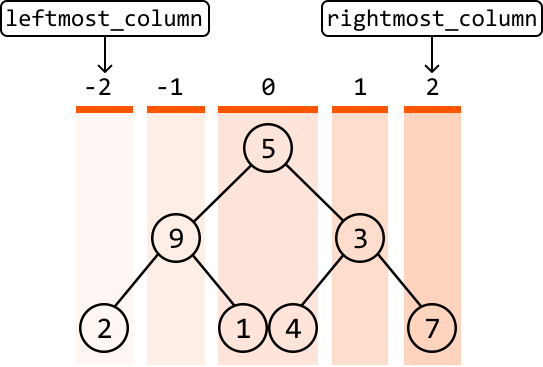
Implementation
from ds import TreeNode
from typing import List
from collections import defaultdict, deque

def binary*tree_columns(root: TreeNode) -> List[List[int]]:
if not root:
return []
column_map = defaultdict(list)
leftmost_column = rightmost_column = 0
queue = deque([(root, 0)])
while queue:
node, column = queue.popleft()
if node: # Add the current node's value to its corresponding list in the hash # map.
column_map[column].append(node.val)
leftmost_column = min(leftmost_column, column)
rightmost_column = max(rightmost_column, column) # Add the current node's children to the queue with their respective # column ids.
queue.append((node.left, column - 1))
queue.append((node.right, column + 1)) # Construct the output list by collecting values from each column in the hash # map in the correct order.
return [column_map[i] for i in range(leftmost_column, rightmost_column + 1)]
function binary_tree_columns(root) {
if (!root) {
return [];
}
const column_map = Object.create(null);
let leftmost_column = 0;
let rightmost_column = 0;
const queue = [[root, 0]];
let head = 0;
while (head < queue.length) {
const [node, column] = queue[head++];
if (node) {
// Add the current node's value to its corresponding list in the hash
// map.
if (!column_map[column]) {
column_map[column] = [];
}
column_map[column].push(node.val);
leftmost_column = Math.min(leftmost_column, column);
rightmost_column = Math.max(rightmost_column, column);
// Add the current node's children to the queue with their respective
// column ids.
queue.push([node.left, column - 1]);
queue.push([node.right, column + 1]);
}
}
// Construct the output list by collecting values from each column in the hash
// map in the correct order.
return Array.from(
{ length: rightmost_column - leftmost_column + 1 },
(*, i) => column_map[leftmost_column + i] || []
);
}
Complexity Analysis
Time complexity: The time complexity of binary_tree_columns is O(n)O(n)O(n) where nnn denotes the number of nodes in the tree. This is because we process each node of the tree once during the level‐order traversal.
Space complexity: The space complexity is O(n)O(n)O(n) due to the space taken up by the queue. The queue’s size will grow as large as the level with the most nodes. In the worst case, this occurs at the final level when all the last‐level nodes are non‐null, totaling approximately n/2n/2n/2 nodes. Note that the output array created at the return statement does not contribute to the space complexity.