Connect the Dots
Given a set of points on a plane, determine the minimum cost to connect all these points.
The cost of connecting two points is equal to the Manhattan distance between them, which is calculated as |x1 - x2| + |y1 - y2| for two points (x1, y1) and (x2, y2).
Example:
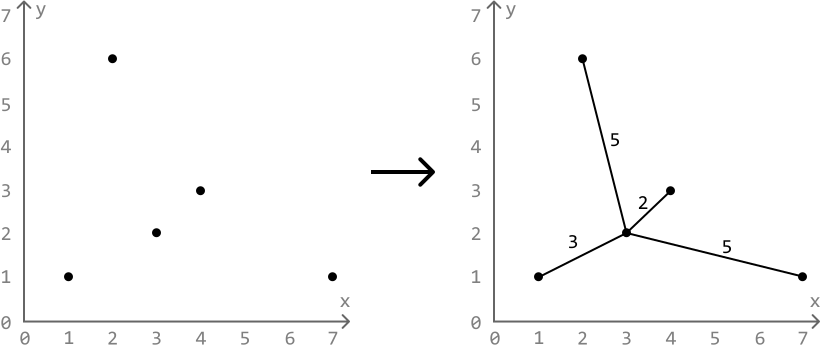
Input: points = [[1, 1], [2, 6], [3, 2], [4, 3], [7, 1]]
Output: 15
Constraints:
- There will be at least 2 points on the plane.
Intuition
Let’s treat this problem as a graph problem, imagining each point as a node, and the cost of connecting any two points as the weight of an edge between those nodes.
The goal is to connect all nodes (points) in such a way that the total cost is minimized. This is essentially the minimum spanning tree (MST) problem:
The MST of a weighted graph is a way to connect all points in the graph, ensuring each point is reachable from any other point while minimizing the total weight of the connections.
There are two main algorithms that are used to find the MST of a graph:
- Kruskal’s algorithm
- Prim’s algorithm
In this explanation, we’ll break down Kruskal’s algorithm since it uses a data structure we’ve already discussed in this chapter: Union-Find.
Kruskal’s algorithm
Kruskal’s algorithm is a greedy method for finding the MST. It essentially builds the MST by connecting nodes with the lowest-weighted edges first while skipping any edges that could cause a cycle.
To do this, we first need to identify all the possible edges and sort them by their Manhattan distance:
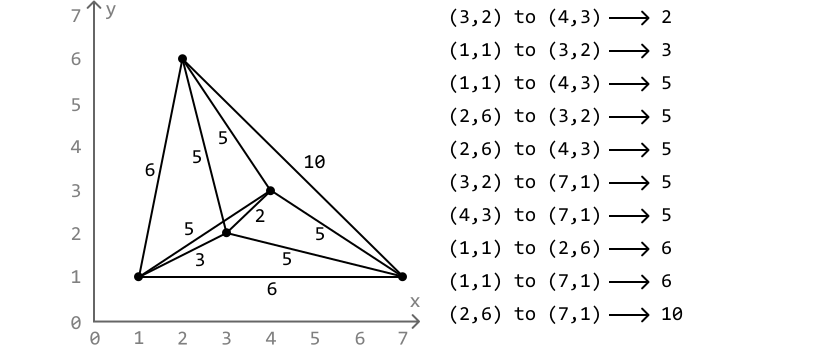
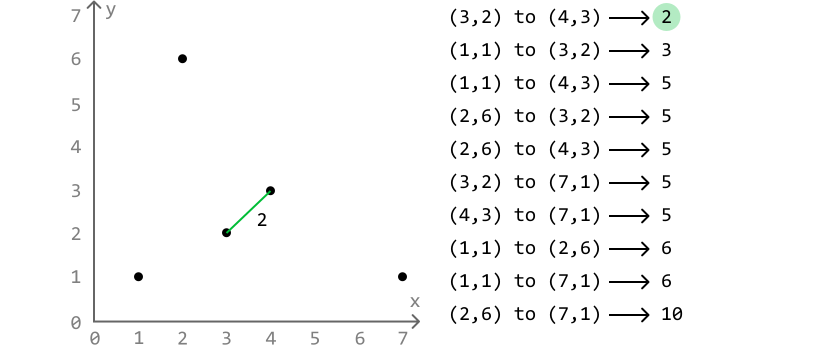
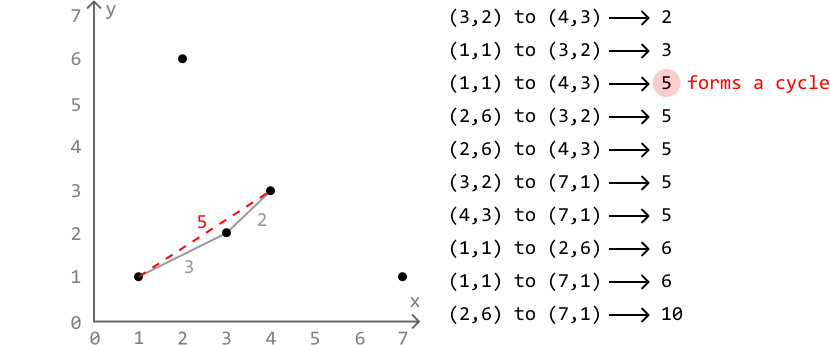
Now, let’s implement Kruskal’s algorithm. Start by including the lowest weighted edge in the MST, which is the edge from (3, 2) to (4, 3):
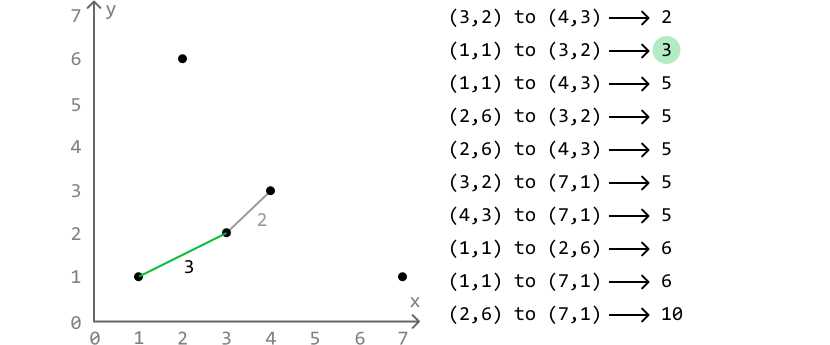
Next, add the next lowest weighted edge, which is the edge from (1, 1) to (3, 2):
Notice that adding the next edge from (1, 1) to (4, 3) will cause a cycle. Edges that cause cycles are avoided in an MST because doing so implies we’re connecting two points that are already connected. So, let’s skip this edge:
Continuing this process until all points are connected gives us the MST:
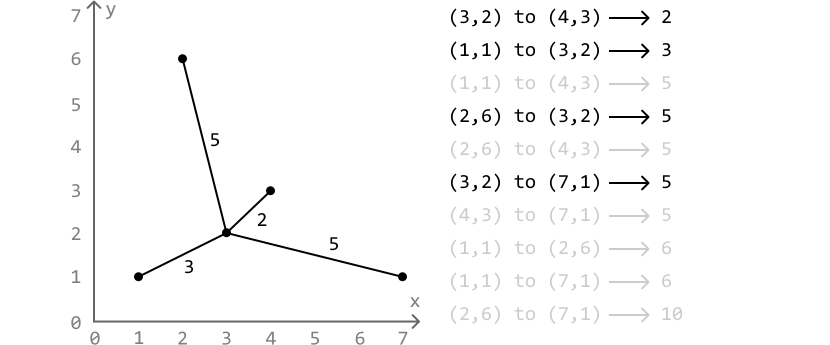
We’ll know that all points are connected once we’ve added a total of n - 1 edges to the MST, because this is the least number of edges needed to connect n points without any cycles. To attain the cost of this MST, we just need to keep track of the Manhattan cost of each edge we add to the MST.
Now that we have a strategy to find the MST of a set of points, we just need a way to determine when connecting two points leads to a cycle.
Avoiding cycles
A cycle is formed when we add an edge to nodes that are already connected in some way. Consider the following set of points, where the group of points to the left are connected, and the group of points to the right are connected:
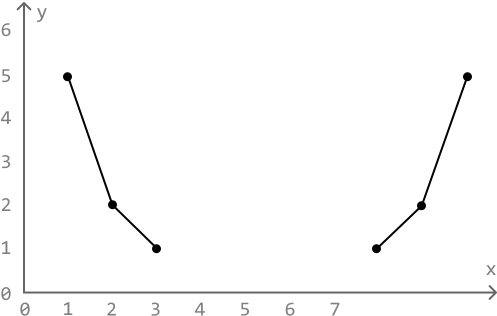
Connecting any two points in the same group causes a cycle, and connecting two points from two separate groups will result in both groups merging into one:
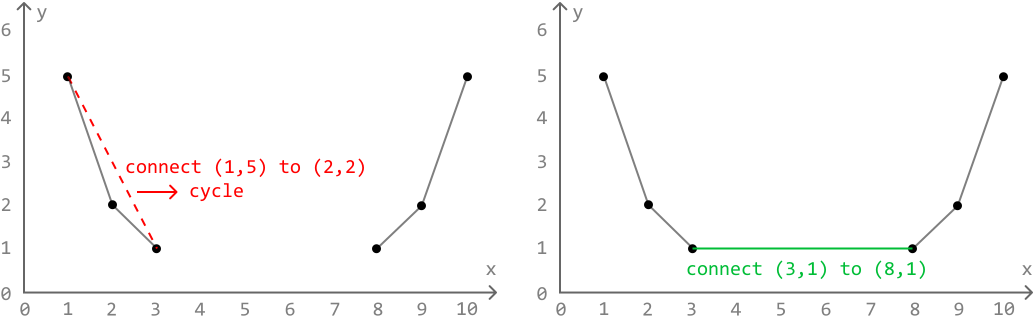
What would be useful here is a way to determine if two points belong to the same group, and a way to merge two groups together. The Union-Find data structure is perfect for this.
We can use the union function to connect two points together.
-
If the two points belong to two separate groups,
unionshould merge those groups and return true. -
Otherwise, if they belong to the same group,
unionshould return false.
This way, we can use this boolean return value as a way to determine if attempting to connect two points causes a cycle.
If you’re not familiar with Union-Find, study the solution to the Merging Communities problem.
Implementation
In this implementation, we’ll identify each point using their index in the points array. This means that for n points, each point is represented by an index from 0 to n - 1. By doing this, we can set up a Union-Find data structure with a capacity of n so that there are n groups initially, with each group containing one of the n points.
Python
JavaScript
Java

from typing import List

def connect_the_dots(points: List[List[int]]) -> int:
    n = len(points)
    # Create and populate a list of all possible edges.
    edges = []
    for i in range(n):
        for j in range(i + 1, n):
            # Manhattan distance.
            cost = (abs(points[i][0] - points[j][0]) +
                    abs(points[i][1] - points[j][1]))
            edges.append((cost, i, j))
    # Sort the edges by their cost in ascending order.
    edges.sort()
    uf = UnionFind(n)
    total_cost = edges_added = 0
    # Use Kruskal's algorithm to create the MST and identify its minimum cost.
    for cost, p1, p2 in edges:
        # If the points are not already connected (i.e. their representatives are
        # not the same), connect them, and add the cost to the total cost.
        if uf.union(p1, p2):
            total_cost += cost
            edges_added += 1
            # If n - 1 edges have been added to the MST, the MST is complete.
            if edges_added == n - 1:
                return total_cost

The Union-Find data structure remains the same as the implementation provided in Merging Communities, with a slight modification made to the union function, adding a boolean return value to it.
Python
JavaScript
Java

class UnionFind:
    def __init__(self, size):
        self.parent = [i for i in range(size)]
        self.size = [1] * size

    def union(self, x, y) -> bool:
        rep_x, rep_y = self.find(x), self.find(y)
        if rep_x != rep_y:
            if self.size[rep_x] > self.size[rep_y]:
                self.parent[rep_y] = rep_x
                self.size[rep_x] += self.size[rep_y]
            else:
                self.parent[rep_x] = rep_y
                self.size[rep_y] += self.size[rep_x]
            # Return True if both groups were merged.
            return True
        # Return False if the points belong to the same group.
        return False

    def find(self, x) -> int:
        if x == self.parent[x]:
            return x
        self.parent[x] = self.find(self.parent[x])
        return self.parent[x]
Complexity Analysis
Time complexity: The time complexity of the connect_the_dots is O(n2log(n))O(n^2\log(n))O(n2log(n)), where nnn denotes the length of the points array, and n2n^2n2 is the number of edges in the edges array, since we consider all possible pairs of points to form edges. Here’s why:
-
Sorting n2n^2n2 edges takes O(n2log(n2))O(n^2\log(n^2))O(n2log(n2)) time, which can be simplified to O(n2log(n))O(n^2\log(n))O(n2log(n)).
-
We perform up to one
unionoperation for each edge, with eachuniontaking amortized O(1)O(1)O(1) time, resulting in theunionoperations contributing amortized O(n2)O(n^2)O(n2) time.
Therefore, the overall time complexity is O(n2+n2log(n))=O(n2log(n))O(n^2+n^2\log(n))=O(n^2\log(n))O(n2+n2log(n))=O(n2log(n)).
Space complexity: The space complexity is O(n2)O(n^2)O(n2) due to the space taken up by the edges list. In addition, the UnionFind data structure takes up O(n)O(n)O(n) space.