Minimum Coin Combination
You are given an array of coin values and a target amount of money. Return the minimum number of coins needed to total the target amount. If this isn’t possible, return ‐1. You may assume there’s an unlimited supply of each coin.
Example 1:
Input: coins = [1, 2, 3], target = 5
Output: 2
Explanation: Use one 2-dollar coin and one 3-dollar coin to make 5 dollars.
Example 2:
Input: coins = [2, 4], target = 5
Output: -1
Intuition - Top-Down
In this problem, there’s no restriction on the number of coins we can use, which makes a brute force approach that tries every possible coin combination impossible, due to the infinite number of possible combinations. This indicates the need for a more efficient method.
Consider the example below:
![Image represents a simple input for a coding problem, likely related to searching or summing within an array. The input consists of two parts presented linearly. The first part is an integer array represented by [1 2 3], enclosed in square brackets, with the integers 1, 2, and 3 separated by spaces. This array is followed by a comma and a space, separating it from the second part. The second part specifies a target value, denoted by target = 5, indicating that the algorithm should search for, or use, the value 5 in relation to the array. There are no URLs or parameters present; the image solely displays the input data. The arrangement suggests that the array [1 2 3] and the target value 5 are independent inputs to a function or algorithm.](/courses/coding-patterns/images/minimum-coin-combination-1.svg)
If we use a 3-dollar coin from the array, then we’ll only need 2 dollars more to make 5. This gives us a new target: find the fewest number of coins needed to make 2 dollars:
![Image represents a simple data flow diagram illustrating a change in a parameter. The diagram begins with the word 'use' positioned above a downward-pointing arrow, indicating the input or application of a parameter. The arrow points to the input data: an array [1 2 3] and a parameter labeled target = 5. A solid arrow then connects this input to a new state, where the array remains the same, [1 2 3], but the target parameter has changed to target = 2. The diagram visually depicts a process where the array remains constant, while the target parameter is modified from 5 to 2, suggesting a change in the input or a transformation within a system.](/courses/coding-patterns/images/minimum-coin-combination-2.svg)
This indicates we’ve identified subproblems within the main problem, where each subproblem requires finding the fewest number of coins needed to make a smaller target.
Each coin we use creates a new subproblem. For example, using a 1-dollar coin changes our target from 5 to 4 dollars. Let’s visualize how these smaller targets, representing new subproblems, are created after using each coin:

In extension, each of these subproblems can be solved by breaking them down into further subproblems:
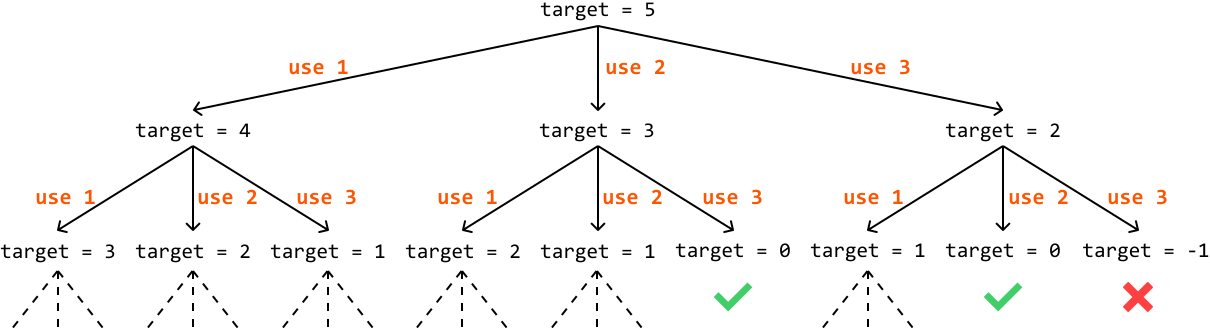
A path that ends with a target of 0 means the coins used in that path add up to 5. If the target becomes negative, it means the path is invalid, so we should stop extending the path.
We’ve observed how new subproblems are created, but haven’t yet addressed how to attain the solutions to them. Remember, each subproblem needs to return the minimum number of coins needed to reach its target.
Consider the main problem with a target of 5. To solve this, we first need to find the minimum number of coins needed to reach each of its three subproblems. The solution to the main problem is the smallest result among these subproblems, plus 1, to account for the coin used to create the subproblem. This highlights an optimal substructure in the problem, allowing us to define the following recurrence relation:
min_coin_combination(target) = 1 + min(min_coin_combination(target - coin_i) | coin_i ∈ coins)
Base case
Naturally, we need a base case for this formula. The base case occurs when the target equals 0, which is the simplest version of this problem, as no coins are needed to meet the target. In this case, we return 0.
Memoization
An important thing to notice is that we might end up solving the same subproblem multiple times. For instance, we calculate the subproblem target = 3 two times in the previous example:
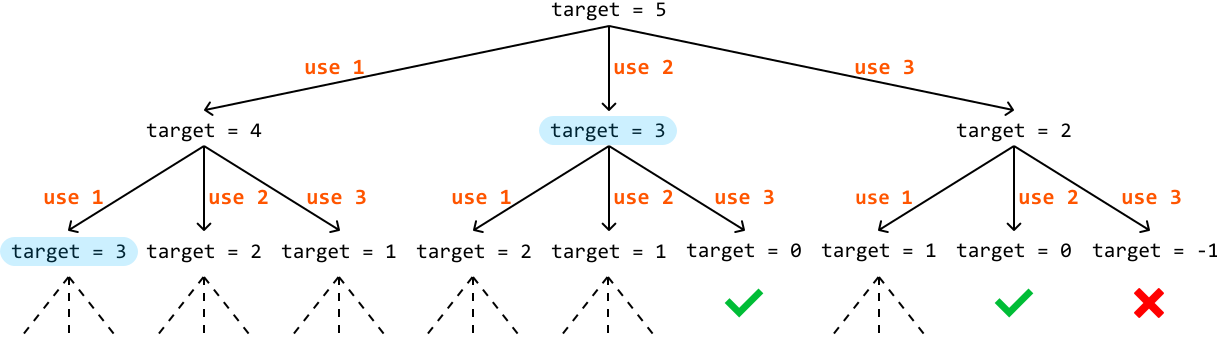
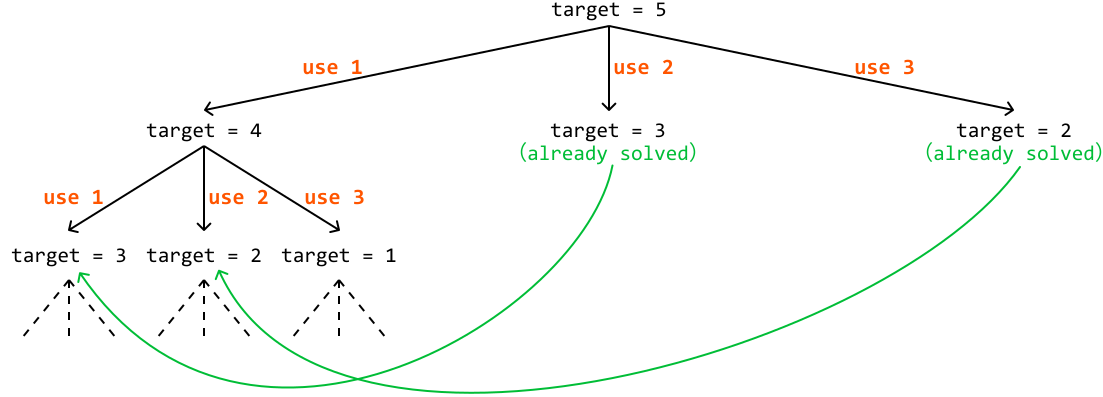
This highlights the existence of overlapping subproblems. Memoization improves our solution by storing the solutions to subproblems as they are computed, ensuring each subproblem is solved only once. This eliminates redundant calculations, and can significantly reduce the size of the recursion tree:
Implementation - Top-Down**
Python
JavaScript
Java

def min_coin_combination_top_down(coins: List[int], target: int) -> int:
    res = top_down_dp(coins, target, {})
    return -1 if res == float('inf') else res

def top_down_dp(coins: List[int], target: int, memo: Dict[int, int]) -> int:
    # Base case: if the target is 0, then 0 coins are needed to reach it.
    if target == 0:
        return 0
    if target in memo:
        return memo[target]
    # Initialize 'min_coins' to a large number.
    min_coins = float('inf')
    for coin in coins:
        # Avoid negative targets.
        if coin <= target:
            # Calculate the minimum number of coins needed if we use the current coin.
            min_coins = min(min_coins, 1 + top_down_dp(coins, target - coin, memo))
    memo[target] = min_coins
    return memo[target]

Complexity Analysis
Time complexity:
-
Without memoization, the time complexity of
min_coin_combination_top_downwould be O(ntarget/m)O(n^{target/m})O(ntarget/m), where nnn denotes the number of coins, and mmm denotes the smallest coin value. The recursion tree has a branch factor of nnn because we make a recursive call for up to nnn coins. The depth of the tree is target/mtarget/mtarget/m because in the worst case, we continually reduce the target value by the smallest coin. -
With memoization, each subproblem is solved only once. Since there are at most targettargettarget subproblems, and we iterate through all nnn coins for each subproblem, the time complexity is O(target⋅n)O(target\cdot n)O(target⋅n).
Space complexity: The space complexity is O(target)O(target)O(target) because, while the maximum depth of the recursive call stack is only target/mtarget/mtarget/m, the memoization array stores up to targettargettarget key-value pairs.
Intuition - Bottom-Up
Using the same technique discussed in the Climbing Stairs problem, we can convert our top-down solution to a bottom-up one by translating the memoization array to a DP array.
First, let’s look at the value our memoization array stores, as shown in the following code snippet of the top-down implementation:
Python
JavaScript
Java

for coin in coins:
    if coin <= target:
        min_coins = min(min_coins, 1 + top_down_dp(coins, target - coin, memo))
memo[target] = min_coins
Translating this to a DP array provides the following code:
Python
JavaScript
Java

for coin in coins:
    if coin <= target:
        dp[target] = min(dp[target], 1 + dp[target - coin])
This code snippet only includes the calculation for one target value. In our top-down solution, this calculation is repeated for every target value from the initial target, down to the base case (target == 0).
In the bottom-up solution, we need to reverse this order by starting with the base case and working our way up to the initial target value (hence the name “bottom-up”). This is necessary because our DP array calculation depends on the DP values of smaller targets. So, we need to calculate the answers for smaller targets first. This can be done using a for-loop from 1 to the target (starting at 1 since the base case of 0 is already set):
Python
JavaScript
Java

for t in range(1, target + 1):
    for coin in coins:
        if coin <= t:
            dp[t] = min(dp[t], 1 + dp[t - coin])
Once this is done, the answer to the problem will be stored in dp[target].
Implementation - Bottom-Up**
Python
JavaScript
Java

def min_coin_combination_bottom_up(coins: List[int], target: int) -> int:
    # The DP array will store the minimum number of coins needed for each amount. Set
    # each element to a large number initially.
    dp = [float('inf')] * (target + 1)
    # Base case: if the target is 0, then 0 coins are needed.
    dp[0] = 0
    # Update the DP array for all target amounts greater than 0.
    for t in range(1, target + 1):
        for coin in coins:
            if coin <= t:
                dp[t] = min(dp[t], 1 + dp[t - coin])
    return dp[target] if dp[target] != float('inf') else -1
Complexity Analysis
Time complexity: The time complexity of min_coin_combination_bottom_up is O(targetn)O(targetn)O(targetn) because we loop through all nnn coins for each value between 1 and targettargettarget.
Space complexity: The space complexity is O(target)O(target)O(target) due to the space occupied by the DP array, which is of size target+1target+1target+1.
Interview Tip
Tip: When a problem asks for the minimum or maximum of something, it might be a DP problem.
If you spot keywords like “minimum”, “maximum”, “longest”, or “shortest”, in the problem description, consider whether a DP approach might be appropriate, as many DP problems involve optimizing a certain value, such as finding the minimum cost, or longest sequence.